
The 2-minute version#
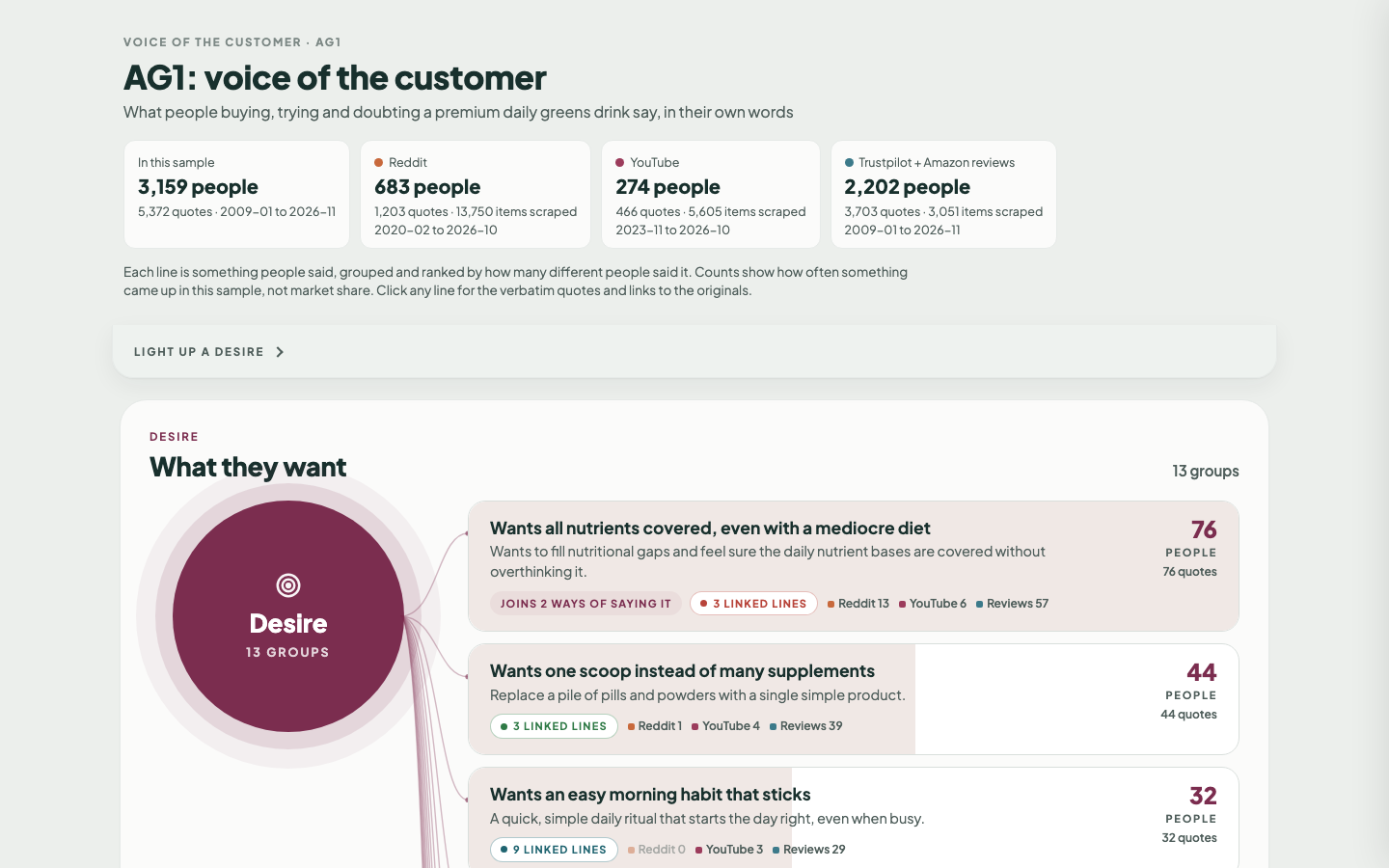
- What you get: one HTML page that ranks what your customers say into themes, counted by distinct people. Click a theme to read the real quotes, each linked to the post or review it came from.
- What it costs: Claude Code on a paid Claude plan, plus $2 to $15 of scraping.
- How long: 20 minutes of setup. Then about 3 hours, most of it waiting.
- How: paste six prompts into Claude Code, one per step. Or paste one prompt that runs them all.
Why bother#
Most DTC copy comes from the founder's head. A Voice of Customer (VoC) report flips that.
You read what thousands of buyers wrote in public, when nobody was selling to them. You learn what they want and the words they use for it. You see what they tried before you, how it went, and what still annoys them.
That's your headlines, your PDP sections and your test backlog. Written by your customers.
Reading 5,000 comments by hand takes a week. Claude Code does it in an afternoon, and you get counts instead of a gut feel. The prompts below are distilled from the pipeline we run for clients at Proofit.
What the board shows#
- Six sections: Desire, Belief, Situation, Pain points, Product experience, Behaviour.
- Ranked rows: themes sorted by how many different people said them.
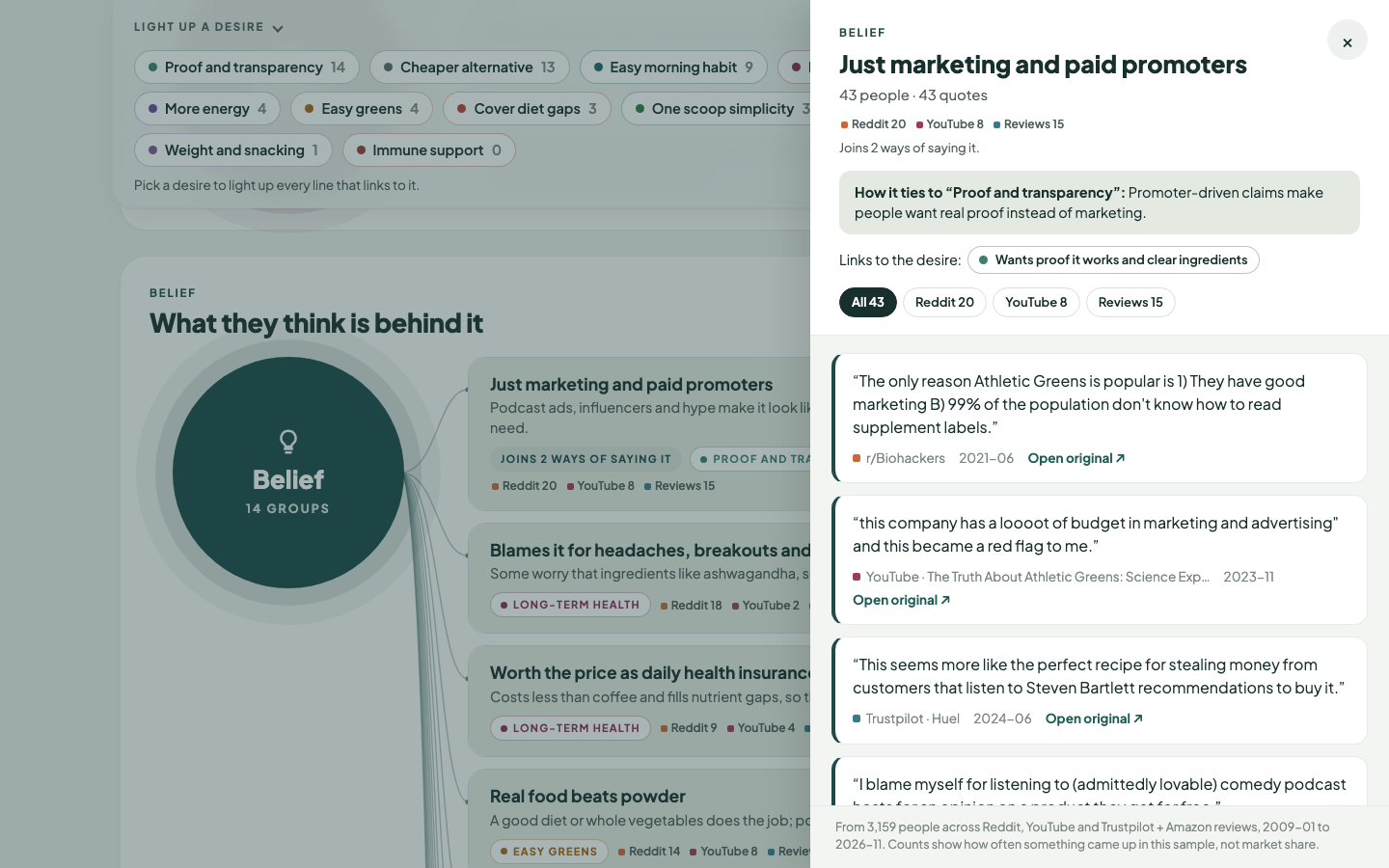
- Desire chips: click "Wants to sleep through the night" and every pain, belief and habit tied to it lights up.
- Quote drawer: the verbatim quotes behind a theme, each with a link to the original.
- Outcome bars: for each product people tried, how many said it worked, failed or stopped working.
- A straight caveat at the top: people in this sample, not market share.
The stack#
Claude Code#
Anthropic's coding agent. It runs in your terminal, writes the scripts and runs them. You don't need to code. You paste prompts and say yes or no.
curl -fsSL https://claude.ai/install.sh | bash
mkdir voc-yourbrand && cd voc-yourbrand
claude
Log in when it asks. A Pro plan works for a small run. Max or API credit is better for a big one (about 100 to 250 model calls).
Scrapers#
Start free where you can:
- Reddit: the Arctic Shift API, a free public Reddit archive. No key, no account. Tell Claude Code to use it.
- YouTube: yt-dlp, a free tool that pulls comments without downloading the video.
For reviews, or for less babysitting, use Apify. It's a marketplace of ready-made scrapers. You pay per result, and the free plan gives you $5 of credit a month.
- Sign up at apify.com.
- Copy your Personal API token from Settings > API & Integrations.
- Save it as an environment variable. Never paste it into the chat.
# Mac (zsh). Paste your token between the quotes, then open a new terminal.
echo 'export APIFY_TOKEN="paste-your-token-here"' >> ~/.zshrc
| Source | Apify actor | Per 1,000 |
|---|---|---|
| trudax/reddit-scraper-lite | about $3.40 | |
| YouTube videos | streamers/youtube-scraper | about $4 (you need under 100) |
| YouTube comments | streamers/youtube-comments-scraper | about $0.90 |
| Amazon reviews | axesso_data/amazon-reviews-scraper | about $0.90 |
| Trustpilot reviews | casper11515/trustpilot-reviews-scraper | about $0.70 |
Prices as listed on apify.com on 3 Nov 2026. A full pull on Apify costs about $12 to $15. Use the free routes for Reddit and YouTube and it's under $2.
Fill in the blanks#
Every prompt uses these. Replace them once, then paste.
| Placeholder | Example |
|---|---|
{{BRAND}} | Acme Sleep |
{{CATEGORY}} | magnesium sleep gummies |
{{TARGET_CUSTOMER}} | Adults who struggle to fall or stay asleep and have tried supplements or apps for it |
{{COMPETITORS}} | Brand A melatonin, Brand B sleep drink |
Optional: {{REVIEWS_FILE}} (a CSV of your own reviews) and {{TRUSTPILOT_DOMAINS}}.
{{TARGET_CUSTOMER}} matters most. It decides who the filter keeps. "Women 35 to 55 with thinning hair who've tried minoxidil or biotin" beats "people interested in hair care".
The six steps#
Open each toggle for the full prompt. Run them in order, in one folder.
Step 0: set the house rules#
This writes a CLAUDE.md file that Claude Code reads every session. The rules: never edit customer text, count people instead of quotes, keep only word-for-word quotes, cache every model call so re-runs are free, and keep your API key out of the chat.
Create a file called CLAUDE.md in this folder with exactly this content, then create the folders raw/, work/, cache/ and out/.

# VoC project: {{BRAND}}
Brand: {{BRAND}}, a {{CATEGORY}} brand.
Target customer: {{TARGET_CUSTOMER}}
Competitors: {{COMPETITORS}}

## House rules
- Don't edit customer text, ever. Store it and quote it exactly as it's written, typos included.
- Every item keeps: id, source, sub_source, author, date (YYYY-MM-DD), url, title, text.
- Count distinct people (authors). Don't count quotes. One person who posts 10 times is 1 person.
- A quote may only appear on the board if it's found word for word in its source item (ignoring case and whitespace). If it isn't, drop it.
- Model work on batches runs from a Python script through `claude -p --model <haiku|sonnet> --output-format json`. Don't read thousands of items into this chat.
- Cache every model call in cache/<step>/<sha1 of the prompt>.json, so a re-run costs nothing.
- APIFY_TOKEN comes from the environment. Don't print it, don't write it to a file and don't ask me for it.
- Ask me before any scrape that'll cost more than $5.
- Folders: raw/ (scraped, untouched), work/ (filtered, extracted, themed), cache/, out/.
Step 1: collect#
Pulls posts, comments and reviews from where your customer talks when you're not in the room. Reddit is candid but skews young. YouTube comments reach older buyers. Amazon and Trustpilot reviews come from people who paid, including for your competitors. The mix stops one crowd from writing your whole board.
Claude Code proposes sources and a cost estimate, then waits for your OK.
Read CLAUDE.md first. We're collecting what {{TARGET_CUSTOMER}} say about {{CATEGORY}}.

1. Propose a source plan and STOP for my OK:
   - 4-8 subreddits where these people talk about the problem (not just the product), plus 5-8 keywords for comment search.
   - 6-10 YouTube searches that surface personal stories and honest reviews ("my ... story", "... after 6 months", "... honest review"), not ads or brand channels.
   - 3-6 Amazon product URLs: ours if we sell there, plus the top competitors ({{COMPETITORS}}). Prefer listings with 500+ reviews.
   - Trustpilot domains with real review volume, if any: {{TRUSTPILOT_DOMAINS}}.
   - An Apify cost estimate for the whole plan, per source.

2. After my OK, write collect.py. It runs these Apify actors through the Apify API (https://api.apify.com/v2), with the token from the APIFY_TOKEN environment variable:
   - Reddit: trudax/reddit-scraper-lite, posts and comments from the subreddits and keyword searches.
   - YouTube: streamers/youtube-scraper to find videos for each search, then streamers/youtube-comments-scraper on the 10-20 most-commented videos that are on topic (up to 400 comments each).
   - Amazon: axesso_data/amazon-reviews-scraper on each product, run once per star rating (1 to 5) to get past the 10-page cap.
   - Trustpilot: casper11515/trustpilot-reviews-scraper on each domain.
   Read each actor's input schema from the Apify API before you call it. Don't guess field names.
   Run each actor with a 20-item test first and show me 3 normalised rows per source. Then run the full pull.

3. Save every raw API response in raw/api/ so we never pay for the same data twice.

4. Normalise every row to one JSON line in raw/<source>.jsonl with: id, source (reddit, youtube, amazon, trustpilot or reviews), sub_source (r/subreddit, video title, product name or site), author (username, channel id or reviewer name), date (YYYY-MM-DD), url (the exact post, comment or review when possible, else the page), title, text. Don't change the text.

5. If I gave you a review export ({{REVIEWS_FILE}}), load it into raw/reviews.jsonl with the same fields.

Targets: about 1,500 Reddit items, 10-20 videos, all available reviews. When you're done, tell me items per source, the date range and what we spent.
Step 2: filter to your customer#
Most raw comments are "great video", jokes, sellers and bots. Simple rules strip those first. Posts that name your brand go too, since they could be seeded. Then a cheap model (Haiku) keeps only your target customer talking about their own life. Reviews skip that screen because reviewers already bought.
Read CLAUDE.md first. We're on step 2. Filter raw/*.jsonl down to {{TARGET_CUSTOMER}} talking about their own experience. Write filter.py.

Rules first, no model:
- Drop Reddit and YouTube items that mention {{BRAND}} (they could be seeded). Keep {{BRAND}}'s own reviews.
- Drop text under 60 characters (under 25 for reviews), exact duplicate text, bots (AutoModerator, RemindMeBot and similar) and items where under 85% of letters are plain English letters.
- Drop incentivised reviews: Vine reviews and text like "received this product free" or "in exchange for an honest review".
Reviews stop here. They're buyers, so they skip the model screen.

Then screen Reddit and YouTube items with `claude -p --model haiku --output-format json`, 90 items per batch, each item cut to 550 characters and numbered [0], [1], ... Use the prompt below for each batch. Don't reword it:

"You screen social posts and comments for customer research.

TARGET PERSON: {{TARGET_CUSTOMER}}

KEEP an item when it's written by the target person (or a family member describing the target person) and holds personal content, such as:
- first-hand experience of the problem and what they tried for it
- a family member describing someone else's experience and what they tried

DROP an item when any of these is true:
- sellers, affiliate pitches, ads, promo codes
- bot or spam text
- non-English text
- no personal content (e.g. "great video", "thanks", jokes, pure questions with no story)
- professionals giving general advice with no personal story

For each kept item also say who is speaking: "self" (the target person) or "family" (a partner, child or relative describing someone else).

Items:
<the numbered batch>

Reply with JSON only, no prose:
{"keep": [{"n": 0, "who": "self"}, ...], "drop": [{"n": 1, "why": "3-6 word reason"}, ...]}
Every item number must appear exactly once, in keep or drop."

Keep at most 1,000 items per source for the next step, picked in a stable random order (shuffle by a hash of the id, not newest first). Write work/kept.jsonl (each item plus "who") and work/filter_log.json (counts per source and drop reasons with counts).

Then show me the counts, 10 random kept items and 10 random dropped items.
Step 3: extract verbatim claims#
Each comment splits into small claims. Each claim gets a category and the exact words the person used. Then a script looks for every quote in the original. If it can't find it word for word, the claim is dropped. Your board never puts words in a customer's mouth.
Read CLAUDE.md first. We're on step 3. Extract claims from work/kept.jsonl. Write extract.py.

First, read 150 random kept items and propose:
- the "items tried" list: 6-12 products or methods these people use for the problem, competitors included,
- the outcome labels: Worked, Failed, Mixed, Stopped working, Too early.
Save both to CLAUDE.md and show me.

Then send kept items to `claude -p --model sonnet --output-format json` in batches (30 items for Reddit, 45 for YouTube and reviews; each item's title plus text cut to 2,200 characters, numbered "=== [n]"; mark family items "[written by a family member about someone else]"). Use the prompt below. Don't reword it:

"You extract voice-of-customer claims for research. Person studied: {{TARGET_CUSTOMER}}

Categories:
- desire: Desire. What they want, in their own terms.
- belief: Belief. What they think causes their problem or why their fixes failed.
- situation: Situation. Their circumstances and history.
- pain: Pain points. What they struggle with day to day and with the fixes they tried.
- product: Product experience. A product or method they tried, and how it went for them.
- behaviour: Behaviour. What they do to cope, apart from products.

For each item below, pull out the distinct claims the writer makes about their OWN experience (or, for family items, the experience of the person they describe). A claim is one idea that fits one category. Most items have 0-3 claims; never more than 5. Skip advice to others, generic statements, jokes and anything not first-hand.

For each claim give:
  "n": item number
  "cat": one category key
  "quote": the exact words from the item that carry this claim, copied character for character (same spelling, punctuation, typos). One to three sentences, at most 45 words. No ellipses, no edits, no joining of separate parts.
  "point": the claim restated in 4-12 plain words, in the writer's terms

For category "product" also give:
  "item": exactly one of: <the items tried list>; or "other: <short name>" if none fits
  "outcome": exactly one of: Worked, Failed, Mixed, Stopped working, Too early ("Too early" = just started)

Items:
<the batch>

Reply with JSON only: {"claims": [{"n": 0, "cat": "...", "quote": "...", "point": "..."}, ...]}"

Verbatim check, in code, for every claim: find the quote in its item's text or title, ignoring case, extra whitespace and straight vs curly quotes. Store the matching text from the original, not the model's copy. If it isn't found, drop the claim and count it. Drop exact duplicates too.

Write work/claims.jsonl with: claim id, item id, source, sub_source, author, who, url, date, cat, quote, point, and item and outcome for product claims. Then tell me: claims proposed, kept, dropped as not verbatim, and kept per category.
Step 4: theme#
Claims group into 5 to 16 themes per section, in the customer's words: "Can't get back to sleep after waking up", not "Sleep maintenance issues". No claim is forced into a theme it doesn't fit. Near-duplicates merge so one idea isn't split across two rows. Then each theme links to the desire it serves.
Read CLAUDE.md first. We're on step 4. Theme work/claims.jsonl. Write theme.py. Use `claude -p --model sonnet --output-format json` for every call.

For each category except product:

1. PROPOSE. Send every claim's "point" (up to 1,400, one per line) with the prompt below. Don't reword it:
"You are grouping voice-of-customer research. People studied: {{TARGET_CUSTOMER}}
Category: <category name and description>.
Below are <N> short claims people made in this category. Propose the themes that cover them.
Theme rules:
- A theme is a plain statement in the customer's own words, short (3-12 words), at a grade 5 reading level.
- Concrete, not abstract: "The strap broke after a week", not "Durability issues".
- No pronoun is needed: drop the subject ("Had the problem for years"). Never use I, my, me, we or you. If a pronoun is unavoidable, use "they".
- One idea per theme. If two themes would get the same headline, they're one theme.
- Desire themes start with "Wants" (e.g. "Wants results that last this time").
- Propose between 5 and 16 themes. Each must be broad enough that many different claims fit it ("Delivery takes too long", not "The parcel came on day 9"), but still one clear idea. Together they should cover at least 85% of the claims. Don't make an "other" theme.
- Also give "sub": one plain sentence (8-16 words) saying what sits under the theme, in the customer's terms.
Claims:
<points>
Reply with JSON only: {"themes": [{"title": "...", "sub": "..."}]}"

2. ASSIGN. In batches of 200, send the numbered theme list and the claims as "id | point | quote" with the prompt below. Don't reword it:
"Assign each customer claim to the ONE theme it clearly says. Pick the theme whose title says the same idea as the claim's quote. A claim that's a clear example of a theme belongs to it. Use 0 (other) only when no theme says what the quote says; don't force a claim into a theme it doesn't support. Reply with JSON only, every id once: {"a": {"<id>": <theme number or 0>}}"

3. LEFTOVERS. If 30+ claims and more than 10% land in 0, propose 2-6 NEW themes from those claims only (tell the model the existing titles so it doesn't repeat them), then re-assign the leftovers against the full list.

4. MERGE. Send each theme with its claim count and 5 example points:
"Find near-duplicates: themes that say the same idea, would get the same headline, or where one is just a narrower case of another (they split one idea's count). Merge those. Keep different ideas apart. Rewrite any title that breaks the theme rules. Reply with JSON only: {"merge": [{"ids": [2, 7], "title": "...", "sub": "..."}], "rename": {"<id>": {"title": "...", "sub": "..."}}}"

For product, don't propose themes. Each item on the items-tried list is a theme ("Tried <item>"). Claims keep their outcome. "other: ..." items go to Not grouped.

5. LINK. Send the desire themes (D1, D2, ...) and every other theme with 3+ people:
"For each desire give a short chip label (2-4 words, plain). For each theme, list the desire it DIRECTLY bears on: the theme is the main obstacle to that desire, the reason for it, or the way people go after it. Be strict. Most themes link to exactly one desire; link a second only when the tie is just as direct. Leave it empty when the tie is loose or generic. Aim for each desire to light up roughly 3 to 12 themes. Add "why": one short plain sentence (max 14 words) on how they connect. Reply with JSON only: {"chips": {"D1": "label"}, "links": {"<theme id>": {"d": ["D1"], "why": "..."}}}"

Write work/themes.json: per category, the themes (id, title, sub, claim ids, linked desires, chip for desires) and the "other" claim ids. Then show me every theme title with its claim count, per category.
Step 5: count people#
One angry person with 12 comments is one person. Counting quotes lets the loudest voices win. Counting distinct people shows how far a theme really reaches. A short check script then proves every quote and every count.
Read CLAUDE.md first. We're on step 5. Build out/voc.json from work/claims.jsonl and work/themes.json. Write build.py.

- people = distinct authors per theme. An author is a Reddit username, a YouTube channel id, or one person per review. A deleted Reddit author counts as one person per item. Family quotes count under the person who wrote them.
- quotes = number of claims in the theme.
- source mix = distinct people per source (reddit, youtube, amazon, trustpilot, reviews).
- Product themes: give each person one outcome. A person with Worked and Failed on the same item counts as Mixed. Otherwise use their most recent outcome. Count people per outcome.
- Themes with fewer than 3 people move to that category's "Not grouped" row.
- Sort each category's themes by people, then by quotes.
- Desire chip count = the number of other themes linked to that desire.
- Sample block: raw items, kept items, people and quotes per source, and the date range.
- Hash every author (first 8 characters of a sha1) so the output is safe to share.

Then write check.py and run it:
1. Every quote is found word for word (case and whitespace ignored) in its source item in raw/, and carries that item's url.
2. Every theme's people count equals the distinct authors of its quotes, and its quotes count equals its quotes.
3. Every category is sorted by people.
4. Every desire chip count equals its linked themes.
If anything fails, fix it and run it again until all four pass. Show me the output.
Step 6: render the board#
One HTML file. Double-click to open it, drop it in Slack or a deck. It works on a phone too.
Read CLAUDE.md first. We're on step 6. Build out/board.html from out/voc.json. One self-contained file: data inlined, opens from a double-click, no server, no outside requests except one Google Font.

Layout:
- Header: "{{BRAND}}: what {{TARGET_CUSTOMER}} say, in their own words". Under it, a sample strip: people, quotes, items per source, date range. Under that, in plain words: "Counts are people in this sample who said it. This isn't market share."
- Desire chips in a row across the top, each with its count. Clicking a chip highlights the linked rows in every section and dims the rest. Clicking again clears it.
- Six sections in this order, each with its own colour: Desire (What they want), Belief (What they think is behind it), Situation (Where they're), Pain points (What they struggle with), Product experience (What they tried and how it went), Behaviour (What they do about it).
- Each row: rank, theme title, sub line, people count with a bar scaled to the biggest row in that section, and small dots for the source mix.
- Product experience rows also show a stacked outcome bar by people: Worked, Failed, Mixed, Stopped working, Too early.
- Each section ends with a "Not grouped" row.
- Clicking a row opens a drawer from the right: theme title, people and quotes counts, source mix, then quote cards. Each card: the verbatim quote, the source label (r/subreddit, video title, Amazon product, Trustpilot), the date, and a "See original" link that opens in a new tab. Interleave sources so each one shows early. Escape closes the drawer.
- Clean and readable: white background, dark text, one accent colour per section, generous spacing.
- Works on a 390px-wide phone with no sideways scroll.

Open it in my browser. Then click three rows and one chip, check the browser console for errors, and fix any.
The run-it-all prompt#
Done the setup and filled in the blanks? Paste this into Claude Code in an empty folder. It runs every step and stops twice for your OK: before it spends money, and after the filter.
You're building a Voice of Customer (VoC) board for {{BRAND}}, a {{CATEGORY}} brand.
Target customer: {{TARGET_CUSTOMER}}.
Main competitors: {{COMPETITORS}}.
Our own review export (optional, csv or xlsx): {{REVIEWS_FILE}}.

Goal: one HTML file that ranks what these people say into themes, counted by distinct people, with every theme backed by verbatim quotes that link to the original post, comment or review.

HOUSE RULES (apply to every step)
- Don't edit customer text, ever. Store it and quote it exactly as it's written, typos included.
- Every item keeps: id, source, sub_source, author, date (YYYY-MM-DD), url, title, text.
- Count distinct people (authors). Don't count quotes. One person who posts 10 times is 1 person.
- A quote may only appear on the board if it's found word for word in its source item (ignoring case and whitespace). If it isn't, drop it.
- Model work on batches runs from a script through `claude -p --model <haiku|sonnet> --output-format json`. Don't read thousands of items into this chat. Cache every call in cache/<step>/<sha1 of prompt>.json so a re-run costs nothing.
- APIFY_TOKEN comes from the environment. Don't print it, don't write it to a file and don't ask me for it.
- Folders: raw/ (scraped, untouched), work/ (filtered, extracted, themed), cache/, out/.
- First, save these house rules and the brand details above as CLAUDE.md in this folder.

STEP 1: COLLECT
1. Propose a source plan and STOP for my OK:
   - 4-8 subreddits where the target customer talks about this problem, and 5-8 keywords for comment search.
   - 6-10 YouTube searches that find personal stories and honest reviews ("my ... story", "... after 6 months"), not ads.
   - 3-6 Amazon product URLs (ours if listed, plus the top competitors) and any Trustpilot domains with real volume.
   - The Apify cost estimate for the plan.
2. After my OK, write collect.py. It calls these Apify actors through the Apify API with the token from APIFY_TOKEN:
   - Reddit: trudax/reddit-scraper-lite (posts and comments from the subreddits and keyword searches)
   - YouTube: streamers/youtube-scraper to find videos, then streamers/youtube-comments-scraper for comments. Pick the 10-20 most-commented videos that are on topic, up to 400 comments each.
   - Amazon: axesso_data/amazon-reviews-scraper, once per star rating (1 to 5) to get past its 10-page cap
   - Trustpilot: casper11515/trustpilot-reviews-scraper, if we use Trustpilot
   Read each actor's input schema from the Apify API before calling it; don't guess field names.
   Run each with a 20-item test first and show me 3 normalised rows per source. Then run the full pull.
   Free fallbacks if I ask: the Arctic Shift API (https://arctic-shift.photon-reddit.com/api, endpoints /posts/search and /comments/search) for Reddit, and yt-dlp for YouTube comments (--skip-download --write-comments --write-info-json --extractor-args "youtube:max_comments=400;comment_sort=top").
3. Save raw API responses in raw/api/ so we never pay twice. Normalise to raw/<source>.jsonl. Load {{REVIEWS_FILE}} into raw/reviews.jsonl if given.
4. I want about 1,500 Reddit items, 10-20 videos, all available reviews. Then tell me items per source, the date range and what we've spent.

STEP 2: FILTER TO THE TARGET CUSTOMER
1. Rules first, no model: drop Reddit and YouTube items that name {{BRAND}} (they could be seeded; keep our own reviews), text under 60 characters (25 for reviews), exact duplicates, bots, mostly non-English text, and incentivised reviews ("free product in exchange for", "Vine").
2. Reviews stop there, since they're buyers. Screen Reddit and YouTube with haiku, 90 items per batch, each item cut to 550 characters, with the prompt below. Don't reword it:
   "You screen social posts and comments for customer research. TARGET PERSON: {{TARGET_CUSTOMER}}. KEEP an item when it's written by the target person (or a family member describing them) and holds personal content: their own experience of the problem, what they tried, how it went. DROP an item when it's a seller, affiliate, ad or promo code; bot or spam; not English; has no personal content (praise, thanks, jokes, a bare question with no story); or is a professional giving general advice with no personal story. For each kept item say who is speaking: "self" or "family". Reply with JSON only: {"keep": [{"n": 0, "who": "self"}], "drop": [{"n": 1, "why": "3-6 word reason"}]}. Every item number must appear exactly once."
3. Keep at most 1,000 items per source, picked in a stable random order (not newest first). Write work/kept.jsonl and work/filter_log.json (counts and reasons).
4. STOP and show me the counts, 10 random kept and 10 random dropped items. I'll check you kept the right people.

STEP 3: EXTRACT VERBATIM CLAIMS
1. Read 150 random kept items and propose the "items tried" list (6-12 products or methods people use for this problem, competitors included) and the outcome labels: Worked, Failed, Mixed, Stopped working, Too early. Save them to CLAUDE.md and show me.
2. Send kept items to sonnet in batches (30 for Reddit, 45 for YouTube and reviews, each item cut to 2,200 characters) with the prompt below. Don't reword it:
   "You extract voice-of-customer claims for research. Person studied: {{TARGET_CUSTOMER}}. Categories: desire (what they want, in their own terms); belief (what they think causes the problem or why fixes failed); situation (their circumstances and history); pain (what they struggle with day to day and with the fixes they tried); product (a product or method they tried and how it went); behaviour (what they do to cope, apart from products). For each item, pull out the distinct claims the writer makes about their OWN experience (or, for family items, the person they describe). A claim is one idea in one category. Most items have 0-3 claims; never more than 5. Skip advice to others, generic statements, jokes and anything not first-hand. For each claim give: n (item number); cat (one category key); quote (the exact words from the item, copied character for character, same spelling, punctuation and typos, 1-3 sentences, at most 45 words, no ellipses, no edits, no joining of separate parts); point (the claim in 4-12 plain words, in the writer's terms). For cat product also give item (one of: <items tried list>, or "other: <short name>") and outcome (one of: Worked, Failed, Mixed, Stopped working, Too early). Reply with JSON only: {"claims": [...]}."
3. Verbatim check in code: for each claim, find the quote in its source item's text or title, ignoring case, whitespace and straight vs curly quotes. Not found: drop it and count it. Also drop exact duplicates.
4. Write work/claims.jsonl (claim id, item id, source, sub_source, author, who, url, date, cat, quote, point, item, outcome). Report proposed, kept, dropped as not verbatim.

STEP 4: THEME
For each category except product:
1. Propose: send sonnet every claim's point (up to 1,400) and ask for 5-16 themes that together cover 85% of them. Theme rules: a plain statement in the customer's words, 3-12 words, grade 5 reading level; concrete, not abstract ("The strap broke after a week", not "Durability issues"); no I, my, me, we or you; one idea per theme (if two themes would get the same headline, they're one theme); desire themes start with "Wants". Each theme also gets a "sub": one plain sentence (8-16 words) on what sits under it. No "other" theme.
2. Assign: in batches of 200, give sonnet the numbered theme list and claims as "id | point | quote", and ask it to put each claim in the ONE theme its quote clearly says, or 0 if none fits. Don't force a claim into a theme it doesn't support. Reply {"a": {"<id>": <n>}}.
3. If more than 10% of claims land in 0, propose 2-6 new themes from those claims only and re-assign them.
4. Merge: show sonnet each theme with its claim count and 5 example points. Merge near-duplicates and themes that are a narrower case of another, so one idea's count isn't split. Fix titles that break the rules.
For product: the themes are the items tried (e.g. "Tried <item>"), and each claim keeps its outcome.
5. Link: give sonnet the desire themes and every other theme. For each theme list the 0-2 desires it directly bears on (the main obstacle to it, the reason for it, or the way people go after it). Be strict; leave it empty when the tie is loose. Aim for each desire to light up 3-12 themes. Also give each desire a 2-4 word chip label.
Write work/themes.json and show me every theme title with its claim count.

STEP 5: COUNT
1. people = distinct authors per theme. Reddit username, YouTube channel id, one person per review. A deleted author counts as one person per item. Family quotes count under the person who wrote them.
2. quotes = number of claims per theme. Source mix = distinct people per source.
3. Product themes: one outcome per person. Worked and Failed from the same person = Mixed.
4. Themes under 3 people fold into that category's "Not grouped" row. Sort each category's themes by people, then quotes.
5. Desire chip count = number of themes linked to it.
6. Write out/voc.json, then write and run check.py: every quote is found word for word in raw/ and carries that item's url; every people count equals the distinct authors of its quotes; every hub is sorted by people. If it fails, fix it and re-run until it's clean.

STEP 6: RENDER THE BOARD
Build out/board.html, one self-contained file that opens by double-click (data inlined, no server, no external requests except fonts).
- Header: "{{BRAND}}: what {{TARGET_CUSTOMER}} say, in their own words", then a sample strip: people, quotes, items per source, date range. Under it, in plain words: "Counts are people in this sample who said it. Not market share."
- Six sections in this order: Desire, Belief, Situation, Pain points, Product experience, Behaviour. Each row: rank, theme title, sub line, people count with a bar scaled to the top row, small source-mix dots.
- Product rows show an outcome bar (Worked / Failed / Mixed / Stopped working / Too early) by people.
- Desire chips across the top. Clicking one highlights its linked rows in every section and dims the rest. Click again to clear.
- Clicking a row opens a side drawer: the theme, its counts, then quote cards. Each card: the verbatim quote, source label (r/subreddit, video title, Amazon product, Trustpilot), date, and a link to the original that opens in a new tab. Mix sources so each shows early.
- Each section ends with a "Not grouped" row.
- Hash author names (first 8 characters of a sha1) so the file is safe to share.
- Works at 390px wide with no sideways scroll.
Open it in my browser when you're done. Then tell me: sources and counts, the top 3 themes per section with people counts, how many quotes failed the verbatim check, and anything that looks thin.
Worked example: AG1#
We ran our full pipeline on public posts, comments and reviews about AG1 and greens powders. Here's what people say, in their own words.
Where the quotes came from: 22,406 items scraped, 3,159 people kept, 5,372 verbatim quotes in 100 themes.
- Reddit: 13,750 posts and comments pulled, 683 people kept (r/AthleticGreens, r/Supplements, r/Biohackers and more).
- YouTube: 5,605 comments from 20 "is AG1 worth it" videos, 274 people kept.
- Reviews: 3,051 reviews (AG1 on Trustpilot, plus Huel, Bloom and Amazing Grass for contrast), 2,202 people kept.
- Apify cost: $1.59. Reddit threads and YouTube comments came from the free routes.
The top themes: (people who said it)
| Section | #1 | #2 | #3 |
|---|---|---|---|
| What they want | All nutrients covered, even with a mediocre diet (76) | One scoop instead of many supplements (44) | An easy morning habit that sticks (32) |
| What they believe | It's just marketing and paid promoters (43) | It causes headaches and breakouts (33) | Worth the price as daily health insurance (32) |
| Where they are | Taken it every day for years (155) | Just started, still testing (58) | Living with a long-term condition (42) |
| Pain points | Costs too much for what it is (267) | Tastes like grass or pond water (202) | Order never came or came late (139) |
| What they do | Drinks it every morning as a habit (174) | Mixes it with other things to hide the taste (109) | Subscription keeps it coming (45) |
Read that pain point row again. Price and taste beat every desire on the board. That's two headline tests and a bundle test before you write a single new ad.
Three quotes worth reading:
"was actually considering getting on board until i saw the price" (YouTube comment)
"I can eat how I eat and still get what I need with one drink a day." (YouTube comment)
"It's like if you mowed your lawn, left the clippings in a black trash bag out in the sun for a few days, and then made tea out of that." (Amazon review, Amazing Grass)
The second one is a headline. The customer wrote it for free.
How to read it#
- Rank by people. 40 quotes from 6 people is a loud minority.
- It's a sample. "120 people" means 120 people in this pull said it. Use it to rank ideas. Don't use it to size a market.
- Know who's talking. Check the source dots before you build a page around one theme.
- Read the quotes before you write. The title is a label. The words that sell are in the drawer.
How to use it#
The board earns its keep once it changes a page or a test. Four patterns we use with clients:
1. Headline. Take the top Desire and the top Pain tied to it. Write [desire, in their words], without [pain, in their words]. "Wants to wake up with energy" plus "coffee crash by 2pm" becomes "Steady energy all morning. No 2pm crash."
2. "Why this is different" section. Product experience shows what they tried before you and why it failed. Name the top 2 or 3 in their words on the PDP, then give the one reason yours works. A big "Stopped working" slice for a competitor is your angle.
3. Offer and FAQ. The top Belief becomes your first FAQ. "Supplements are all marketing" is a trust problem, so lead with proof and a guarantee. "Nothing works for me" is a hope problem, so lead with stories from people who felt the same.
4. Test backlog. Every high-ranked theme your page ignores is a test. Because [N] people said "[quote]", we believe [change] for [segment] will lift [metric]. Rank the backlog by people. Your customers just wrote your test roadmap.
Want us to run it for you?#
This guide is the lean version. At Proofit we run the full pipeline for DTC brands, with more sources and a human review of every theme. Then we turn the board into copy and run the A/B tests that show which words sell.
If you'd like one built for your brand, book a call here.
Proofit, CRO for DTC brands